Overview
Everybody has a personality. Being able to understand and describe yourself can have a tremendous impact on your sense of success and life fulfillment. To begin this journey of examining how you became you, we will look at the psychoanalytic movement. The first and most prominent figure of the psychoanalytic approach is its founder, Sigmund Freud (1856–1939). Freud is a suitable place to start, as every theory after his was in response to his claims about how a person’s personality developed. If you have ever used words such as libido, fixation, or neurotic, it means you have been influenced by Freud, whether consciously or unconsciously.
Topics
This unit is divided into the following topic(s):
- Prelude—What is Psychology?
- Sigmund Freud: The Founder of Psychoanalysis
Unit Learning Outcomes
When you have completed this unit, you will be able to:
- Evaluate the development of the psychoanalytic approach and the structure of personality: the id, the ego, and the superego
- Describe core principles of psychoanalytic thought, highlighting the contributions of Sigmund Freud
- Analyze the concepts of defence mechanisms against anxiety and the extensions of Freudian theory with ego psychology and object relations theory
- Assess the psychosexual stages of personality development and use of free association and dream analysis for assessment
Learning Activities
Here is a list of learning activities that will benefit you in completing this unit. You may find it useful for planning your work.
Assessment
See the Assessment section in Moodle for assignment details.
Resources
Here are the resources you will need to complete this unit.
- Schultz, D. P., Schultz, S. E., & Maranges, H. M. (2024). Theories of personality (12th ed.). Cengage Learning.
- Other online resources will be provided in the unit.
1.1 Prelude—What is Psychology?
Before we dive into the topic of psychology, let me ask you some fundamental questions to help set you up for success in this course. The first question is: God—what comes to mind at the mention of this word?
The intention in asking your thoughts around God is to get you to think about the filter you view reality from. Your worldview shapes how you interpret everything; understanding your predispositions will help you to acknowledge how you’ll be perceiving the information that you learn in psychology.
Other questions that could be asked include: How does your belief or disbelief in God shape how you see yourself? Your role in this world? Your family? Your friends? Humanity in general? Your future? How do you use your resources, such as time, talents, and money?
Theos (Θεός) is the Greek word used for God in the New Testament of the Bible. It reflects God’s position in, and relationship with, creation. As the God of the Bible is relational, it logically follows that when God is involved in your life, you will see changes happening in your life.
When considered in relation to the Greek word theaomai (θεάομαι), meaning to gaze upon, to see, to discern with the eyes, to look at me, the word theos can also mean you can look at Him, and, to see the power.
When we seek answers about how God approaches His activities, two Greek words are particularly significant:
- Eudokia (εὐδοκία): meaning good pleasure, purpose, delight, or favour
- Thelō (θέλω): meaning desire, intention, or the exercise of will
These descriptors indicated that God deeply feels as He engages in relationship with all of creation, while at the same time, beyond feeling, will always do what is best as that aligns with His character. God’s word is true, and He keeps his promises; God is also love, and this characteristic infuses everything that God does. This is the direction of sanctification for people who are in relationship with God.
Understanding the Word Psychology
Now, let’s take some time to think about the following questions:
- What is your understanding of the word psychology?
- How has it been presented to you, and what does it involve?
To help you answer these questions, we should explore the origin of the word “psychology.” Today, psychology is the scientific study of thinking, feeling, and behaviour. The word psychology, though, is an English conjugate of two Greek words: psuche (ψυχή) and logos (λόγος). Put together then, psychology can be understood as an ongoing dialogue and investigation of the totality of a person’s inner life and actions.
1.1.1 Activity: What is Psychology
Issues in Personality Theory
With the origins and definition of psychology in mind, here are the six issues discussed in every major theory of personality.
- Free will or determinism? Do we have a conscious awareness and control of ourselves? Are we free to choose, to be masters of our fate, or are we victims of biological factors, unconscious forces, or external stimuli?
- Nature or nurture? Is our personality determined primarily by the abilities, temperaments, or predispositions we inherit, or are we shaped more strongly by the environments in which we live?
- Past, present, or future? Is personality development basically complete in early childhood? Or is personality independent of the past, capable of being influenced by events and experiences in the present and even by future aspirations and goals?
- Uniqueness or universality? Is the personality of each individual unique or are there broad personality patterns that fit large numbers of persons?
- Equilibrium or growth? Are we primarily tension-reducing, pleasure-seeking animals or are we motivated primarily by the need to grow, to reach our full potential, to reach for ever-higher levels of self-expression and development?
- Optimism or pessimism? Are human beings basically good or evil? Are we kind and compassionate, or cruel and merciless?
Take a moment to pause and consider the issues mentioned above. What is your stance on each one? What are your reasons for your views? How do you think these factors influence human behaviour and personality?
1.2 Sigmund Freud: The Founder of Psychoanalysis
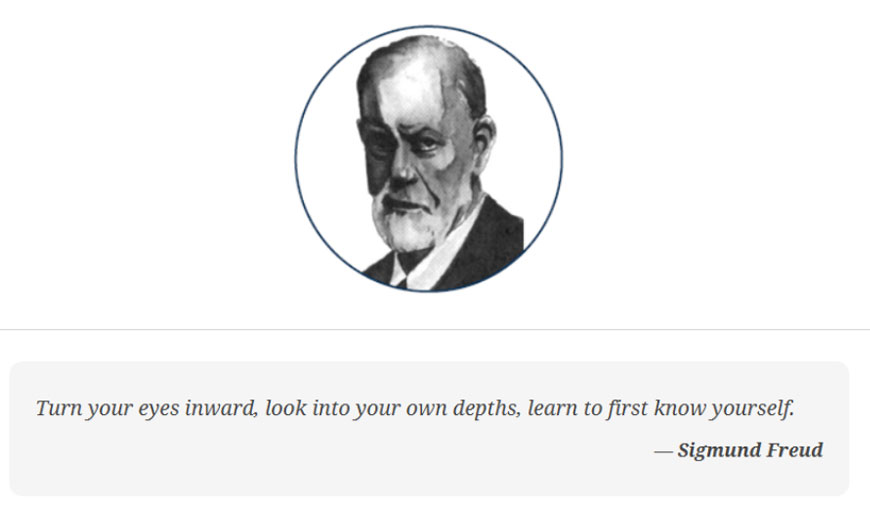
Source: Theories of personality by Schultz et al., 2024, Cengage Learning. Copyright 2025.
As we begin, we consider Sigmund Freud. Freud’s system of psychoanalysis was the first comprehensive theory of personality of the 20th century and has been the most influential. His ideas profoundly guided views of human nature that shaped a broad aspect of the treatment of human beings in psychology and psychiatry. His presence is still felt in the sense that his ideas, though often controversial, are still being considered and applied today. As you learn more about Freud and the construction of a personality theory, hopefully you come to appreciate the significance of the task he undertook in describing the processes involved in you becoming you. I hope you are also able to think critically about his proposals and see where they may be applicable in your life, as well as about concepts with which you may disagree. In particular, is there any evidence that you may have a fixation based on an unsuccessful resolution of one of the psychosexual stages? Also, look for ways to notice if classifying your behaviour as id, ego, or superego dominant is a suitable explanation for what you’re doing, or, if the use of defence mechanisms is present in your behaviour or that of others.
1.2.1 Activity: Who Was … Sigmund Freud
1.2.2 Activity: Sigmund Freud—Psychoanalysis
1.2.3 Activity: What is Psychoanalysis? (Optional)
1.2.4 Activity: History Versus Sigmund Freud
1.2.5 Activity: Personality—Where Does it Come From and How Does it Work?
1.2.6 Activity: Superego Versus Style—A One-Day Experiment
Note: The following learning activity serves as a discussion prompt for this unit. Read it carefully and post your response in the corresponding discussion forum.
I hope you enjoyed your journey through psychoanalysis and have gained an appreciation of the challenges associated with developing a comprehensive theory of personality. Though there are areas where Freud was criticized, ideas such as the influence of unconscious brain activity on our actions, the importance of early childhood in shaping personality, and the connection between the mind and body are topics still being explored today. Freud deserves credit for his profound contributions to understanding personality development, how psychopathology can develop and be persistent, and designing different approaches to treating these illnesses through therapy.
Unit Summary
In Unit 1, you have had the opportunity to learn about the psychoanalytic theory of Sigmund Freud. Through the readings and activities, you were provided with an overview of the key concepts and themes of his personality system, and how his approach describes the etiology and adjustments to personality.