Overview
After many decades with psychopathology being at the forefront of psychological investigation, humanistic psychologists proposed that the focus change to looking toward the highest potential of human beings. While examining what could and does go wrong with people leads to a plethora of knowledge about disordered thinking, feeling, and acting, Abraham Maslow (1908–1970) and Carl Rogers (1902–1987) wanted to gather information instead about what helps people flourish in this life.
The humanistic approach represented a fundamental shift in psychology that greatly expanded topical knowledge and transformed the relationship between therapist and client. Holistic well-being in all areas of a person’s life was discussed in both theory and practice, and now the client—not the therapist—was the expert of their own life. Theories and concepts of humanistic psychology have influenced virtually every system of contemporary life in areas such as education, health care, law enforcement, banking, politics, family functioning, counselling, and psychotherapy.
Topics
This unit is divided into the following topic(s):
- Abraham Maslow: Needs–Hierarchy Theory
Unit Learning Outcomes
When you have completed this unit, you will be able to:
- Analyze Maslow’s theory of personality development
- Evaluate the study of self-actualizers
- Critique research and assessment of Maslow’s theory
- Assess self-determination theory
Learning Activities
Here is a list of learning activities that will benefit you in completing this unit. You may find it useful for planning your work.
Assessment
See the Assessment section in Moodle for assignment details.
Resources
Here are the resources you will need to complete this unit.
- Schultz, D. P., Schultz, S. E., & Maranges, H. M. (2024). Theories of personality (12th ed.). Cengage Learning.
- Other online resources will be provided in the unit.
7.1 Abraham Maslow: Needs–Hierarchy Theory
Source: Theories of personality by Schultz et al., 2024, Cengage Learning. Copyright 2025.
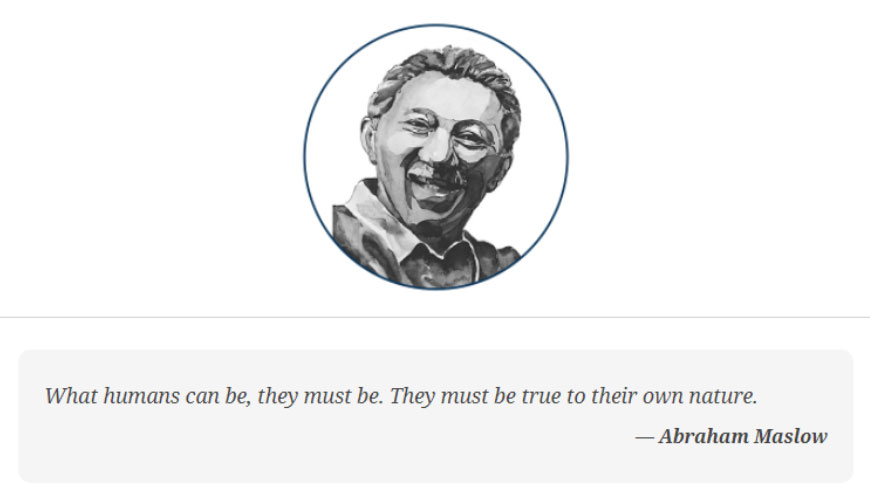
Against the backdrop of the first two forces in psychology—psychoanalysis and behaviourism—Abraham Maslow began forging a new path for psychology. He himself was once a devout behaviourist. While at the University of Wisconsin he worked with Harry Harlow, who is well-known for his baby monkey experiments that would serve as the foundation for John Bowlby’s attachment theory. However, after Maslow’s wife, Bertha, had their first baby girl (they had two daughters) and being moved by what he witnessed during the Second World War, he was determined to develop a psychology that motivated people to strive toward higher aspirations and be the best human beings they could be. His work led to the development of the original hierarchy of needs, which contained what he believed were the five innate needs that drove people to want more out of life (see Figure 9.1 in the course textbook). Maslow developed his motivational theory based on a desire for people to have a new and different understanding of why we do what we do and why we want what we want. You’ll notice as you read the chapter that Maslow overcame many difficulties, received encouragement as he forged his path, and in the end accomplished his goal of humanizing psychology.
7.1.1 Activity: Abraham Maslow: Needs–Hierarchy Theory
7.1.2 Activity: Why Maslow’s Hierarchy of Needs Matters
7.1.3 Activity: Understanding Motivation Through Self-Determination Theory
Initially, Maslow’s hierarchy of needs theory was embraced and flourished not in psychology, but in management theory. The business world simplified Maslow’s ideas and applied them to productivity and profits. The psychological world eventually embraced Maslow’s work of humanizing psychology, launching this third force into the field. Moving on from here, extending, yet in many ways returning to, Kurt Goldstein’s (a German neurologist and psychiatrist, who was an inspiration to Maslow) original proposal that self-actualization is a unifying, holistic process reflected in all living things, Carl Rogers next puts forth his understanding of what self-actualization is—a fully functioning person.
Unit Summary
In this unit you have had the opportunity to learn about the contributions of Abraham Maslow to humanistic psychology. Undoubtedly, you have encountered information from this humanistic standpoint in different areas of your life. The work of Maslow, along with that of Rogers—which we will cover in the next unit—set the groundwork for the trajectory of motivational theory, which became the third force in the field of psychology. This theory’s appeal is nested in the actualization tendency, which is the humanistic explanation for every person’s innate desire to move toward maximizing their potential. According to motivational theory, when this tendency is thwarted, it produces distress that can manifest in multitudinous ways in that individual’s experience.