Overview
Behaviourism has an indelible effect on the way many human (and other animal) interactions are understood, structured, and progressed. As indicated by the name, the focus of behaviourism is not on unconscious forces, intentions, emotions, or whatever else might be happening inside an organism, but solely on observable behaviour.
The approach, also known as the second force in psychology, was originally popularized by John B. Watson (1878–1958). Watson aimed to make psychology a respectable scientific discipline through objective experimental research that increased knowledge about how to predict and control behaviour. For Watson, the way to do this was by focusing on what was observable and amenable to the scientific method—human and animal behaviour.
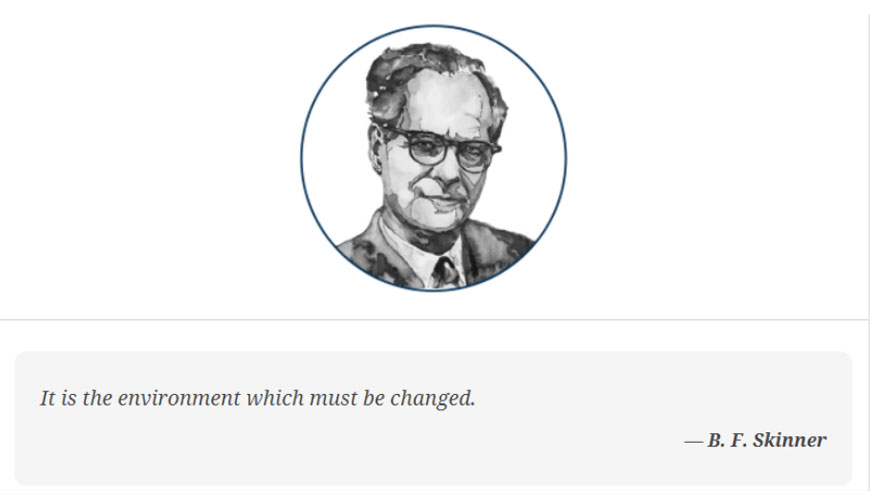
Burrhus Frederic (B. F.) Skinner (1904–1990) built upon Watson’s approach with great vigour and discipline. Skinner also based his work on Edward Lee (E. L.) Thorndike’s (1874–1949) Law of Effect: behaviour that produces something satisfying will increase; however, the opposite is true for unsatisfying behaviour. Skinner’s work with rats and pigeons that established behaviourism as a learning theory is now seen as a fundamental explanation for how rewards and punishments can be used to influence and predict behaviour.
Topics
This unit is divided into the following topic(s):
- B. F. Skinner: Reinforcement Theory
Unit Learning Outcomes
When you have completed this unit, you will be able to:
- Analyze Skinner’s concept of reinforcement as the basis of behaviour and the applications of operant conditioning
- Assess operant conditioning, the Skinner box, and schedules of reinforcement
- Evaluate successive approximations, superstitious behaviour, and the self-control of behaviour
- Critique assessment and research of Skinner’s theory
Learning Activities
Here is a list of learning activities that will benefit you in completing this unit. You may find it useful for planning your work.
Assessment
See the Assessment section in Moodle for assignment details.
Resources
Here are the resources you will need to complete this unit.
- Schultz, D. P., Schultz, S. E., & Maranges, H. M. (2024). Theories of personality (12th ed.). Cengage Learning.
- Other online resources will be provided in the unit.
9.1 B F Skinner: Reinforcement Theory
Source: Theories of personality by Schultz et al., 2024, Cengage Learning. Copyright 2025.
As we begin, we consider some of the behaviours and responses that seem to be somewhat automatic for you. For example, why do you say what you say about yourself when you look in the mirror? Why do you approach your relationship with food the way that you do? Why do you have the bedtime routine that you do? Why do you avoid certain people or situations?
From B. F. Skinner’s perspective, the answer is simple: you do what you do because you have been rewarded for some things and punished for others. In Skinner’s operant conditioning learning theory, a reward is simply something that increases the likelihood of a behaviour or response, and a punishment is something that decreases a behaviour or response. For Skinner, concepts regarding the shaping of behaviour serve as the reason for why people are the way they are. Consequently, Skinner does not offer a detailed developmental description concerning personality; rather, he believes that universally, people are just acting out a series of behaviours in different contexts that they have learned over their lifetime.
9.1.1 Activity: B. F. Skinner: Reinforcement Theory
Classical Conditioning Versus Operant Conditioning
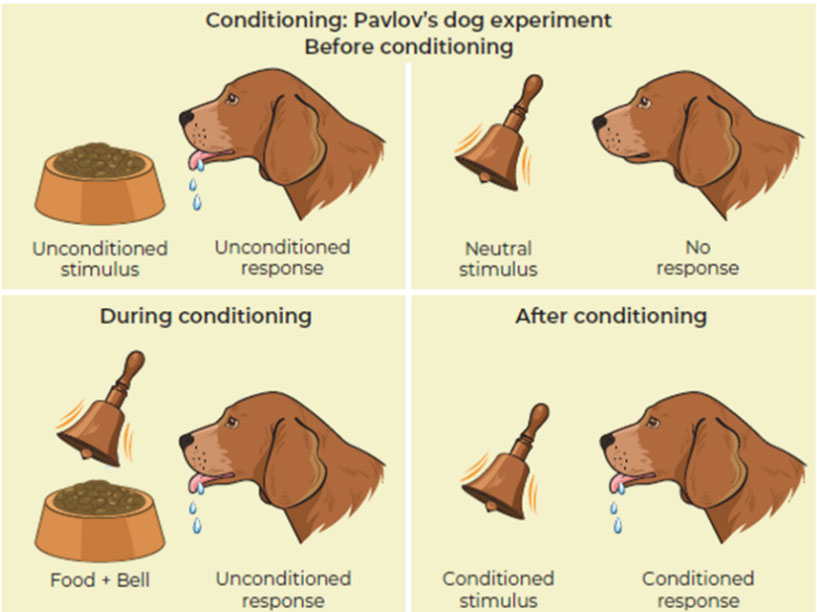
Classical conditioning involves learning through association. This concept was first explored by Ivan Pavlov, who demonstrated that a neutral stimulus, when paired repeatedly with an unconditioned stimulus, can eventually trigger a conditioned response. For example, in Pavlov’s experiments, dogs learned to salivate at the sound of a bell when it had been consistently associated with the presentation of food. In classical conditioning, the learner is passive, and the behaviour is elicited automatically by the stimulus.
Source: Theories of personality (Schultz et al., 2024, p. 301). Copyright 2025 by Cengage Learning.
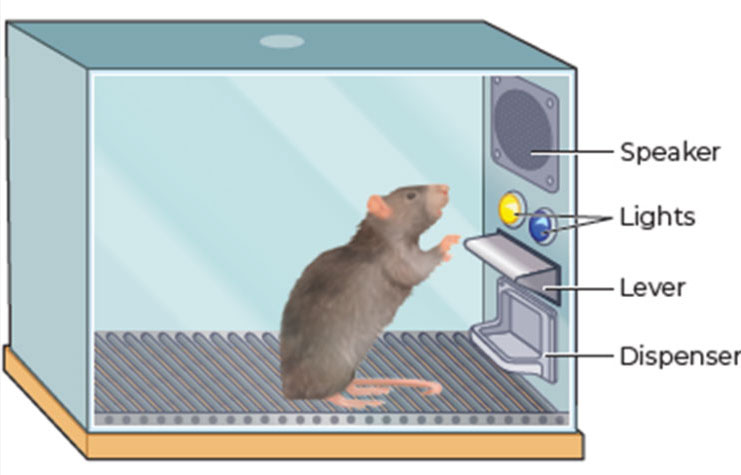
In contrast, B. F. Skinner argued for operant conditioning, which involves learning through consequences. Rather than associating two stimuli, operant conditioning is about strengthening or weakening voluntary behaviours based on reinforcement or punishment. Skinner demonstrated this by using devices such as the “Skinner box,” where animals learned to press a lever to receive food. In this type of conditioning, the learner is active, and behaviour is shaped by the rewards or punishments that follow it.
Source: Theories of personality (Schultz et al., 2024, p. 301). Copyright 2025 by Cengage Learning.
Refer to the table below to see how generative AI analyzes the key aspects of classical and operant conditioning. Does this align with your understanding? Do you agree or disagree with any points? Is there anything you would like to add?
Table Differences between Classical and Operant Conditioning
| Aspect | Classical Conditioning | Operant Conditioning (B. F. Skinner) |
|---|---|---|
| Founder | Ivan Pavlov | B. F. Skinner |
| Type of behaviour | Involuntary (automatic responses) | Voluntary (intentional behaviours) |
| Key concept | Association between two stimuli | Consequences shape behaviour (reinforcement or punishment) |
| Learning process | Stimulus → Response | Behaviour → Consequence → Future Behaviour |
| Example | Dog salivates when hearing a bell (after conditioning) | Child cleans room to earn allowance |
| Focus | What precedes the behaviour (stimulus) | What follows the behaviour (consequence) |
| Role of reinforcement | Not central | Central to learning process |
| Role of the learner | Passive | Active |
| Main applications | Phobias, taste aversion, emotional responses | Behaviour modification, education, training, therapy |
Generated by Microsoft Copilot (Microsoft, 2025)
9.1.2 Activity: Operant Conditioning and Free Will
9.1.3 Activity: Operant Conditioning
Contributions, Challenges, and Contemporary Applications
It is undeniable that Skinner produced a tremendous amount of research support for his theory, working primarily with rats and pigeons. As mentioned in the textbook, Skinner and his followers conducted thousands of experiments examining reinforcement schedules, successive approximation, behaviour modification, and for those who worked with humans, superstitious behaviour and language acquisition, though researchers acknowledge that behaviourism cannot fully explain this latter complex behaviour.
Contemporarily, the latter point highlights the weakness of behaviour therapy as a singular approach, as it often is not sufficient on its own to produce lasting change in complex behaviours. This is why animals trained using behavioural techniques experience instinctive drift, and why behaviourists were not able to shape people into whatever direction they believed they could, though they conducted hundreds of studies trying unsuccessfully to prove this belief.
However, behaviour therapy as an adjunct with other therapies such as motivational interviewing and cognitive therapy are helpful for addressing complex psychological matters.
9.1.4 Activity: Interview with Skinner (Optional)
B. F. Skinner, along with John B. Watson, produced and promoted what came to be known as behaviourism. This second force in psychology profoundly shaped all countries and cultures that embraced it, and it helped cement psychology as a scientific discipline. With its benefits and detriments, the legacy of behaviourism is still felt powerfully across many institutions in societies across the world.
Skinner also insightfully recognized that technologies could be used to shape behaviours and design cultures; a reality experienced daily by those who engage with various forms of social media. Interestingly, Skinner believed behavioural technologies could be used to correct the world’s problems; sadly, most of the research investigating social media’s effects on its users does not support this belief.
Eventually, Skinner’s purposeful ignoring of phenomena of the mind and downplaying of the importance of internal processes would ultimately be the variable that weakened the hold behaviourism held over psychology as a discipline, opening the way for the cognitivist movement.
Many believe that Albert Bandura was one of the fathers of the cognitive movement—his social cognitive theory will be considered next.
Unit Summary
In this unit you have had the opportunity to learn about one of the two influential figures in the behaviourist movement—B. F. Skinner. Skinner’s operant conditioning learning theory, along with Bandura’s social cognitive theory—which we will cover in the next unit—have greatly contributed to the behaviourist mega-theory and its robust explanatory power. Behaviourism and its applications are both ubiquitous and universal. Today, they have had a tremendous effect not only in the fields of psychology and psychiatry, but also in education, medicine, athletics, business, politics, international relations, and the penal system.