Overview
The next person we consider on this journey is Carl Jung (1875–1961). Jung was one of Freud’s most promising students; he was being groomed to be Freud’s successor. However, Jung himself was an independent thinker, and after several years began disagreeing with Freud around some of his most central tenets. This led to the dissolution of their relationship and Jung’s promotion of his theory of personality development, which he named analytical psychology. As we explore the foundational theories of Freud and Jung in psychoanalytic psychology, you will be able to analyze how these approaches shape research and guide our understanding of personality. Extending from this, early detractors from Freud’s approach who became known as the neo-Freudians, starting with Carl Jung, and including Alfred Adler, Erik Erikson, and Karen Horney, contributed to personality theory development in unique and profound ways that shaped what the field is today. As you learn about each of these theorists (except for Erikson, who we do not cover in this course) you will gain an even deeper appreciation of the complexity of factors that contribute to making you you.
Topics
This unit is divided into the following topic(s):
- Carl Jung: Analytical Psychology and Human Nature
Unit Learning Outcomes
When you have completed this unit, you will be able to:
- Evaluate the development and systems of personality according to Jung
- Analyze the use of word association, symptom analysis, and dream analysis for assessment
- Evaluate the Myers-Briggs Type Indicator as a tool for assessing personality in the context of Jungian theory
Learning Activities
Here is a list of learning activities that will benefit you in completing this unit. You may find it useful for planning your work.
Assessment
See the Assessment section in Moodle for assignment details.
Resources
Here are the resources you will need to complete this unit.
- Schultz, D. P., Schultz, S. E., & Maranges, H. M. (2024). Theories of personality (12th ed.). Cengage Learning.
- Other online resources will be provided in the unit.
2.1 Carl Jung: Analytical Psychology and Human Nature
Source: Theories of personality by Schultz et al., 2024, Cengage Learning. Copyright 2025.
Carl Jung, though initially powerfully shaped by psychoanalysis, is more appropriately categorized as one of the most influential contributors to the neo-psychoanalytic approach. One key feature of the neo-psychoanalytic perspective is that it paints a more optimistic and flattering picture of human nature (contrasted with Freud’s perspective, which was quite deterministic and pessimistic).
2.1.1 Activity: Becoming Your True Self - The Psychology of Carl Jung
2.1.2 Activity: Carl Jung: Analytic Psychology
Jung, as mentioned earlier, was to be the heir and future promoter of psychoanalysis; however, Jung had three major areas of disagreement with Freud:
- Jung broadened the idea of the libido as a more generalized psychic energy (a life-oriented instinctual force that provides energy to the mind) that wasn’t merely sexual in nature.
- Jung saw both the past and the future as directional influences on one’s personality, whereas Freud saw people as prisoners of their past.
- Jung extended the role of the unconscious (the underlying forces that shape thoughts and behaviour) to include not only one’s own experiences (as Freud did) but also to include other ancestors including prehuman species. He named this aspect of the unconscious the collective unconscious and made it a core component of his personality system.
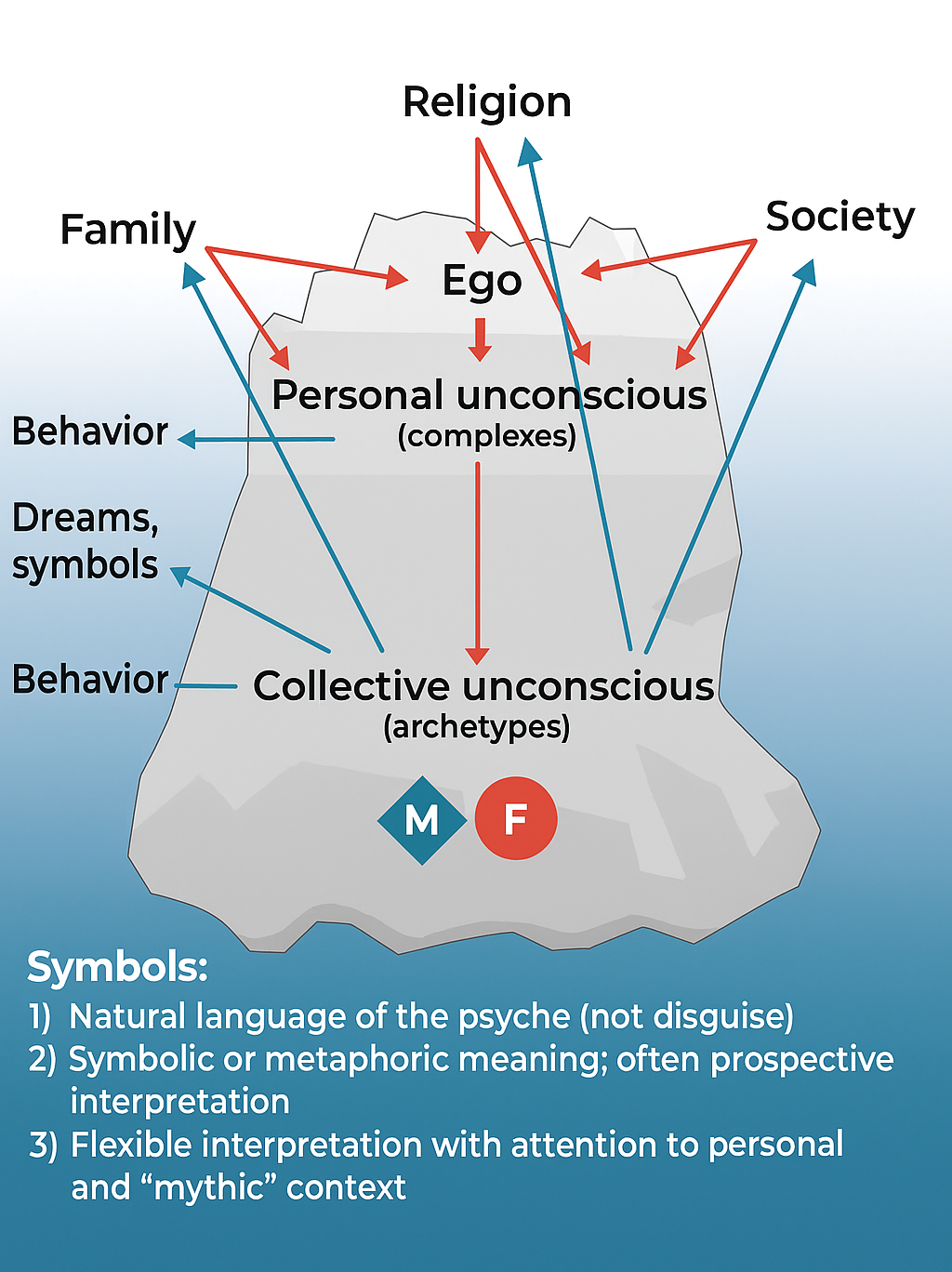
Another key feature of Jung’s system of personality is that it was constructed by combining ideas from physics, history, mythology, anthropology, and religion to form his perspective of human nature. The psyche, Jung’s term for personality, derives its energy from the libido, and the movement of that energy, termed psychic energy, follows three principles Jung based on physics. These principles are opposites, equivalence, and entropy. It is important to understand these principles as they govern how energy is transferred around each of the systems that comprise the psyche. The main systems of the psyche are the ego, personal unconscious, and collective unconscious (see the illustration below), and within each of them are distinct systems derived from Jungian interdisciplinary investigations. Please refer to the textbook at any time to learn about, or refresh your memory, regarding any of these terms.
Source: Theories of personality (Schultz et al., 2024). Copyright 2025 by Cengage Learning.
2.1.3 Activity: Carl Jung’s Word Association Test
2.1.4 Activity: Scenario-Based Questions – Freud Versus Jung
2.1.5 Activity: Freud, Jung, and the Psychology of Myth
2.1.6 Activity: Research on Online Personality Tests
Unit Summary
In Unit 2 you have had the opportunity to learn about the analytical theory of Carl Jung. Through the readings and activities, you were provided with an overview of the key concepts and themes of his personality system, and how his idea has been used to shape therapeutic processes.
Additionally, a fact not thoroughly explored in the textbook is that both Freud and Jung had strong opinions regarding religion and spirituality. Freud had a low opinion of the role of religion and spirituality in one’s life (see The Future of an Illusion, 1961) and some unusual ideas regarding religion in general (see Totem and Tabu, 1913, and Moses and Monotheism, 1939). Conversely, Jung embraced the powerful role religion and spirituality could play in a person’s life and encouraged his clients to pursue this resource as he personally witnessed its mental health benefits.