6  Raymond Cattell and Other Trait Theorists

Overview

In the previous unit you were introduced to Gordon Allport, who was the first to bring academic respectability to the traits discipline, and who emphasized the uniqueness of each person. In this unit, you will continue by exploring the work of Raymond Cattell and other theorists.

Topics

This unit is divided into the following topic(s):

  • Raymond Cattell and Other Trait Theorists

Unit Learning Outcomes

When you have completed this unit, you will be able to:

  • Evaluate Cattell’s approach to personality traits
  • Assess source traits (the basic factor of personality) and dynamic traits (motivating forces)
  • Compare the influences of heredity and environment
  • Evaluate assessment and research in Cattell’s theory
  • Evaluate Eysenck’s dimensions of personality and temperament theory by Buss and Plomin
  • Compare the use of the five-factor model by McCrae and Costa

Learning Activities

Here is a list of learning activities that will benefit you in completing this unit. You may find it useful for planning your work.

  • Watch the video that provides a clear overview of trait theory.
  • Read Chapter 8, “Raymond Cattell, Hans Eysenck, the Five-Factor Theory, HEXACO, and the Dark Triad,” in the textbook.
  • Read the article on the “Big Five” personality traits.
  • Watch the video on personality tests, then explore different types of personality tests on your own.
  • Read the instructions for First Impressions—A Trait-Based Reflection and share your reflections in the Learning Community.

Note: Working through course activities will help you to meet the learning outcomes and successfully complete your assessments.

Assessment

See the Assessment section in Moodle for assignment details.

Resources

Here are the resources you will need to complete this unit.

  • Schultz, D. P., Schultz, S. E., & Maranges, H. M. (2024). Theories of personality (12th ed.). Cengage Learning.
  • Other online resources will be provided in the unit.

6.1 Raymond Cattell and Other Trait Theorists
Source: Theories of personality by Schultz et al., 2024, Cengage Learning. Copyright 2025.

Up to this point, the psychoanalytic and neo-psychoanalytic theories and Allport’s focus on personality assessment have been idiographic, in that their methods of assessment were intended to produce large amounts of subjective data relevant to only one person. There weren’t any standardized tests developed from these approaches. Unlike the previous topics, in this topic you will look at many theorists who have contributed to the trait perspective.

It starts with Raymond Cattell, who through great determination, discipline, and sacrifice put forth a comprehensive personality theory that was sensitive to both genetic and environmental personality factors. His work produced nine different categories of traits, as cited in Schultz et al. (2024):

  • Common
  • Unique
  • Ability
  • Temperament
  • Dynamic
  • Surface
  • Source
  • Constitutional
  • Environmental-Mold

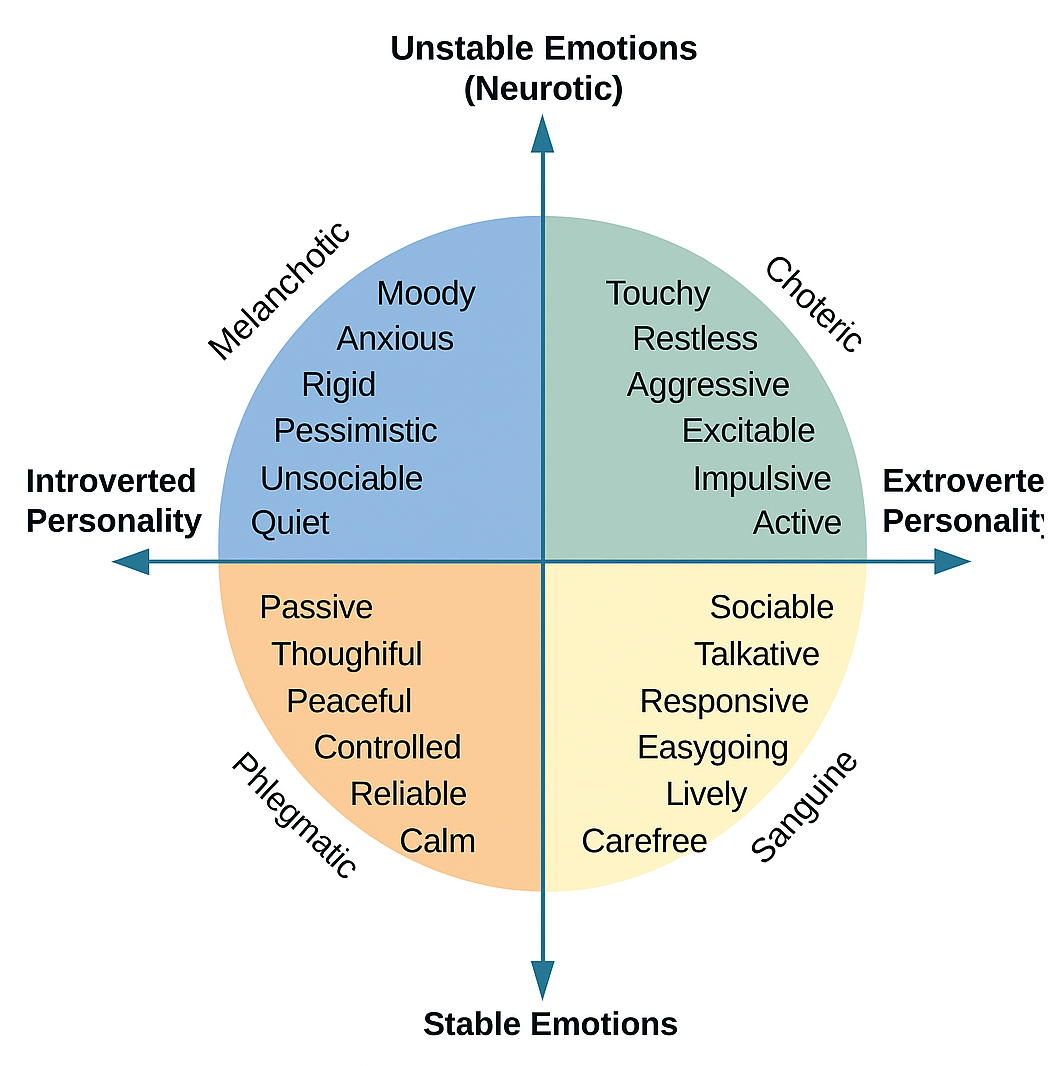
Hans Eysenck and his wife Sybil put forth a theory of personality that is much more genetically focused. Through their extensive and culturally diverse research they proposed three personality superfactors, as cited in Schultz et al. (2024):

  • Extraversion
  • Neuroticism
  • Psychoticism

Source: Psychology – H5P edition, by Spielman et al., (2021), BCcampus, Licensed under CC BY 4.0.

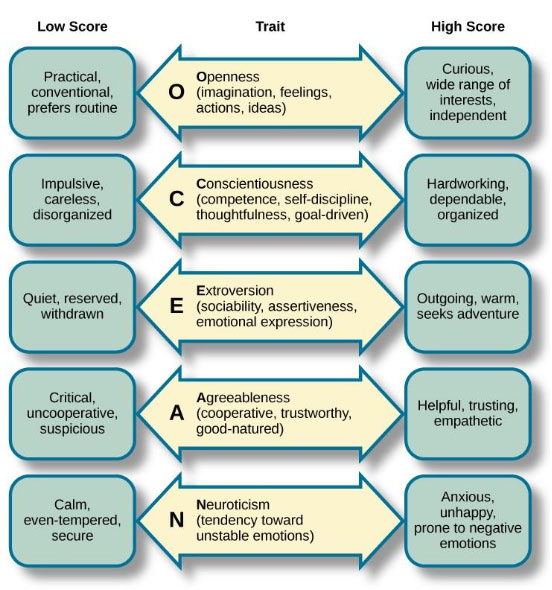
Criticisms about the lacking Eysenck theory and the over-abundant Cattell theory led Robert McCrae and Paul Costa to develop an extensive, yet manageable, personality theory. Their research has put forth the most widely utilized and recognized personality approach, known as the five-factor model. The five factors are:

  • Openness to experience
  • Conscientiousness
  • Extraversion
  • Agreeableness
  • Neuroticism

Source: Psychology – H5P edition, by Spielman et al., (2021), BCcampus, Licensed under CC BY 4.0.

Michael Ashton and Kibeom Lee propose a six-factor theory of personality known as HEXACO. The dimensions included in this approach are:

  • Honesty/humility
  • Emotionality
  • Extraversion
  • Agreeableness
  • Conscientiousness
  • Openness to experience

Lastly, Delroy Paulhus and Kevin Williams introduce a three-factor model for examining the darker side of personality. The traits used in this model are:

  • Narcissism
  • Machiavellianism
  • Psychopathy

6.1.1 Activity: History of Personality Psychology

Estimated Time: 15 mins

Watch this video on Trait Theory (Practical Psychology, 2019) that provides an overview of some of the foundational principles of personality theory, how it is measured, and its application.

Questions to Consider

  • How does this video explain traits? How is it different from or related to cultures, rules, or behaviour?
  • What are the key points about Allport, Cattell, and Eysenck that are described in this video?
  • How did standardized personality tests come to be developed?

6.1.2 Activity: Raymond Cattell and Other Traits Theorists

Estimated Time: 90 mins

Now you’ll read Chapter 8, “Raymond Cattell, Hans Eysenck, the Five-Factor Theory, HEXACO, and the Dark Triad,” in Theories of Personality (Schultz et al., 2024).

This chapter shifts the foundation of personality testing to the nomothetic approach. These theorists looked for universally shared characteristics in order to create standardized tests for the purpose of personality description and prediction of behaviour. The theorists discussed in this chapter created standardized personality assessments from which objective data could be compared with the results of others. These standardized tests fell into one of two categories: tests of normality (e.g., the Sixteen Personality Factor Questionnaire (16PF), the Psychoticism-Extraversion-Neuroticism inventory (PEN), and the NEO Personality Inventory–Revised (NEO-PI-R)), and tests of abnormality (e.g., the Dark Triad, and Minnesota Multiphasic Personality Inventory (MMPI)—not discussed in this textbook). Since these are descriptive assessments, it is important not to moralize profiles as good or bad, rather it is better to understand the results on a spectrum considering the environments where these traits are healthy/unhealthy, beneficial/detrimental, or adaptive/maladaptive.

Use the following interactive slides to support your reading. They provide a brief summary and key points for each section, designed to guide your active reading—much like a navigation map!

6.1.3 Activity: The “Big Five” Personality Traits

Estimated Time: 45 mins

Read What Are the Big 5 Personality Traits? (Cherry, 2025). This article provides an excellent overview of the history, development, uses, and descriptions of the “Big Five” personality factors.

For additional learning, view this video about The Big Five Personality Traits (5:39) (Sprouts, 2019).

6.1.4 Activity: Personality Tests

Estimated Time: 60 mins

Let’s begin by watching this Do Personality Tests Work? - Merve Emre (Emre, 2020) on personality tests.

Explore different type of personality tests and take the one (or more) you’d like.

Questions to Consider

  • How much do you agree with the results?
  • Do the results from different tests show consistency?
  • Which personality tests did you find most useful and accurate in your own context?
  • Which personality tests would you recommend to your friends or colleagues?

6.1.5 Activity: First Impressions–A Trait-Based Reflection

Note: The following learning activity serves as a discussion prompt for this unit. Read it carefully and post your response in the corresponding discussion forum.

Estimated Time: 60 mins

Using language from one or many of the trait personality perspectives presented in the textbook or online resources, write a paragraph (around 250–300 words) to answer the following questions:

  • Hypothetically speaking, if you went on a blind date, what are five characteristics you hope the other person would notice about you?
  • What are five characteristics that would cause you to run away from them?

Unit Summary

In Units 5 and 6 you have had the opportunity to learn about the trait approach to personality theory. We covered the major theorists, each of whom added new and important dimensions to this scientifically rigorous field. Allport was the first to bring academic respectability to this discipline, and he emphasized the uniqueness of each person. Cattell, through a laborious factor analytic approach, created the 16-PF, an instrument designed to capture the 16 personality factors he believed produced a comprehensive description of a person’s personality type. Hans Eysenck believed in and promoted a genetically based personality theory centred around three super-factors: extraversion, neuroticism, and psychoticism. Costa and McCrae, also through extensive factor analysis, put forth the “Big Five” personality factors that purportedly produce an extensive, stable personality representation. Lee and Ashton added one more distinct and valuable personality dimension to the five-factor model, the honesty/humility factor, to produce a somewhat original personality theory. Lastly, Paulhus and Williams delve into the more unsavoury aspects of personality through their dark triad approach that examines narcissism, Machiavellianism, and psychopathy.

Checking Your Learning

Before you move on to the next unit you may want to check that you are able to:

  • Evaluate Cattell’s approach to personality traits
  • Assess source traits (the basic factor of personality) and dynamic traits (the motivating forces)
  • Compare the influences of heredity and the environment
  • Evaluate assessment and research in Cattell’s theory
  • Evaluate Eysenck’s dimensions of personality and temperament theory by Buss and Plomin
  • Compare the use of the Five-Factor Model by McCrae and Costa

References

123test team. (2025). Personality test. https://www.123test.com/personality-test/.
Cherry, K. (2025). What are the big 5 personality traits? In Verywell Mind. https://www.verywellmind.com/the-big-five-personality-dimensions-2795422.
Emre, M. (2020). Do personality tests work? In YouTube. https://www.youtube.com/watch?v=lN7Fmt1i5TI.
Lee, K., & Ashton, M. C. (2009). HEXACO Personality Inventory-Revised (HEXACO-PI-R). https://survey.ucalgary.ca/jfe/form/SV_0DHbQPy5Vr0TAlE.
Open Source Psychometrics Project. (2019). Take a personality test. https://openpsychometrics.org/.
Open-Source Psychometrics Project. (n.d.). Cattell’s 16 personality factors test. https://openpsychometrics.org/tests/16PF.php.
Practical Psychology. (2019). Trait theory - History of personality psychology. In YouTube. https://www.youtube.com/watch?v=oUgCIvKxbAE.
Schultz, D. P., Schultz, S. E., & Maranges, H. M. (2024). Theories of personality (12th ed.). Cengage Learning.
Spielman, R. M., Dumper, K., Jenkins, W., Lacombe, A., Lovett, M., & Perlmutter, M. (2021). Psychology - H5P edition. BCcampus.
Sprouts. (2019). The big five personality traits. In YouTube. https://www.youtube.com/watch?v=IB1FVbo8TSs.