Overview
When searching your mind to strategize how to describe yourself or other people, what formulations do you consider as you accomplish this task? Some may paint a picture, while others might compose a piece of music. The reality is there are myriad ways to creatively communicate how you understand your own or someone else’s personality; however, most people will use words (more specifically, adjectives) to perform this activity. Whether you realize it or not, due to the prevalence of this approach you have likely had some form of experience with trait theory.
As you progress through this and the following units, you will see that traits can be understood in various and nuanced ways. However, all definitions of the term trait take into account that people have characteristic patterns of behaviour that dispose them to act and feel in generally consistent ways.
Topics
This unit is divided into the following topic(s):
- Gordon Allport: Motivation and Personality
Unit Learning Outcomes
When you have completed this unit, you will be able to:
- Evaluate Allport’s nature of personality and personality traits
- Assess motivation and personality development according to Allport
- Critique assessment and research of Allport’s theory
Learning Activities
Here is a list of learning activities that will benefit you in completing this unit. You may find it useful for planning your work.
- Read Chapter 7, “Gordon Allport: Motivation and Personality,” in the textbook.
- Watch the video to explore how personality psychology has evolved over time and learn how Gordon Allport’s perspective contributed.
- Watch Gordon Allport’s interview, where he recounted his experience meeting Freud, and reflect on how the two psychologists’ perspectives differ.
- Apply Allport’s personal-document technique to your own current context.
Note: Working through course activities will help you to meet the learning outcomes and successfully complete your assessments.
Assessment
See the Assessment section in Moodle for assignment details.
Resources
Here are the resources you will need to complete this unit.
- Schultz, D. P., Schultz, S. E., & Maranges, H. M. (2024). Theories of personality (12th ed.). Cengage Learning.
- Other online resources will be provided in the unit.
Gordon Allport: Motivation and Personality
Source: Theories of personality by Schultz et al., 2024, Cengage Learning. Copyright 2025.
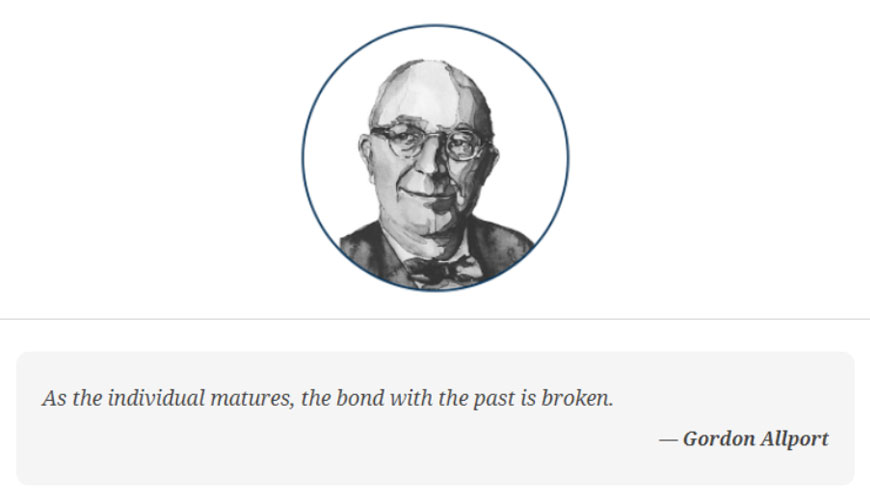
As we begin, consider in 1936 Gordon Allport and Henry Odbert embarked on a journey to discover how many words there were that could be used to describe people. To accomplish this task, they counted all the words in an unabridged dictionary and found nearly 18,000 descriptors. From that list they narrowed it down to just under 4,500 adjectives that, to them, were observable semipermanent personality traits. Allport carried on developing his personality theory, and rather than constructing a generalizable personality system (which many after him would do), he chose to emphasize the uniqueness of each person. By applying systematic scientific processes, Allport modernized the study of personality, making it an academically respectable topic and a mainstream psychological discipline. He is considered one of the foundational contributors to the now burgeoning field of personality psychology.
Activity: Gordon Allport: Motivation and Personality
Read Chapter 7, “Gordon Allport: Motivation and Personality,” in Theories of Personality (Schultz et al., 2024).
Use the following interactive slides to support your reading. They provide a brief summary and key points for each section, designed to guide your active reading—much like a navigation map!
Activity: Measuring Personality
Allport’s and Odbert’s systematic approach to describing personality revealed the multitude of adjectives people use to describe other people. Throughout the history of psychology, various perspectives and methods have emerged to measure personality.
In this video, Measuring Personality (CrashCourse, 2014), you will explore how these approaches have evolved over time—across different cultures and eras—leading to the modern understanding of personality. The speaker explains the trait theory of personality, introducing Gordon Allport’s perspective (1:33–3:15) and his contribution to the development of contemporary personality theory.
Questions to Consider
- What is the range of descriptors you use for people when you are asked about what someone is like?
- Allport prefers keeping personality descriptors in the present; when you’re describing yourself or others, do you focus on the past, present, or future (preferred self or way you would like someone to be)?
- Do you know someone who could be described by a cardinal trait?
Activity: Allport Challenges Freud*
Allport had opposing views from those of Freud on unconscious forces dominating personality and historical determinism. While Freud emphasized unconscious past influences, Allport believed that conscious, present motives are more important in determining personality. Allport viewed humans as rational and purposeful, not just driven by hidden instincts or past trauma.
In this video – Gordon Allport on Meeting Freud (flactemb, 2020), you will see Allport, in his own voice, recounting his experience of meeting Freud during an interview.
Questions to Consider
- Do you agree with Allport’s emphasis on conscious, present motives, or with Freud’s focus on unconscious, past influences?
- When thinking about measuring your own personality, which approach makes more sense to you?
- Can you think of someone for whom the opposing view might make more sense to apply?
Activity: Personal-Document Technique
Allport criticized psychologists who insisted that experimental and correlational methods were the only legitimate ways to study personality. He argued that there is no single best technique—personality is so complex that to evaluate it, we must employ many techniques. He listed 11 major methods for evaluating personality: constitutional and physiological diagnosis; cultural setting, membership, and role; personal documents and case studies; self-appraisal; conduct analysis; ratings; tests and scales; projective techniques; depth analysis; expressive behaviour; and synoptic procedures.
Allport relied heavily on the personal-document technique, which involves examining a person’s written or spoken records to identify the number and kinds of personality traits. Now, as we live in the era of multimedia and social networks, consider the following questions for deeper reflection and application:
- What are the examples of personal document sources that were used in Allport’s time?
- What are the examples of personal document sources that are no longer valid today, or that have newly emerged since Allport’s time?
- By examining personal document sources—your own or someone else’s—try to identify examples of cardinal, central, and secondary traits.
- Did you find this process useful or insightful? Why or why not?
- Did anything surprise you about what the documents revealed (or didn’t reveal)?
- Do you think different types of documents revealed different kinds of traits?
A unique feature of Allport’s theory is the functional autonomy of motives in adulthood. He proposed that healthy adults are no longer influenced by the needs of childhood and could pursue with freedom desires related to their maturity and values. Conversely, Allport recognized that becoming a heathy adult was powerfully affected by mother–child bonds experienced early in life. Insecurity due to poor attachment in childhood seems to act as a barrier to being able to leave childhood motives behind.
Questions to Consider
- Do you think that in relation to the development of the proprium, poor experiences with one’s primary caregiver(s) trap a person in an endless cycle of trying to meet childhood needs?
- In what ways does insecurity influence a person’s traits (whether cardinal, central, or secondary)?
- Could establishing one’s own priority of values help move a person toward functional autonomy of motives?
As we move from developmental perspectives to descriptive or predictive perspectives, it can be helpful to hold on to the question, “Why do I behave the way I do?”
Unit Summary
In Unit 5 you have had the opportunity to learn about the trait approach to personality theory. Allport was the first to bring academic respectability to this discipline, and he emphasized the uniqueness of each person.
In the next unit we will cover other major theorists who each added new and important dimensions to this scientifically rigorous field.
Before you move on to the next unit you may want to check that you are able to:
- Evaluate Allport’s nature of personality and personality traits theory
- Assess motivation and personality development according to Allport
- Critique assessment and research of Allport’s theory
References
CrashCourse. (2014). Measuring personality: Crash course psychology #22. https://www.youtube.com/watch?v=sUrV6oZ3zsk.
flactemb. (2020). Gordon Allport on meeting Freud. In YouTube. https://www.youtube.com/watch?v=bxtY7YP1cpA.
Schultz, D. P., Schultz, S. E., & Maranges, H. M. (2024). Theories of personality (12th ed.). Cengage Learning.