Overview
In the previous unit, you were introduced to the neo-psychoanalytic approach of Alfred Adler (1870–1937). In this unit, you will continue with the work of Karen Horney (1885–1952) (pronounced horn-eye).
Horney agreed with Adler’s belief that social factors were very powerful in shaping a person. For Horney, the driving force for people was to attain a sense of love and security, and the satisfaction of these needs, or lack thereof, formed the beliefs and behaviours that a person would be known by. Importantly, Horney also recognized the lack of attention toward the development of female personalities, and from her work feminine psychology was born.
Topics
This unit is divided into the following topic(s):
- Karen Horney: Neurotic Needs and Trends
Unit Learning Outcomes
When you have completed this unit, you will be able to:
- Describe the early family life of Karen Horney and how her childhood affected her theories of personality and her view of childhood needs
- Compare Horney’s 10 neurotic trends with Freud’s defence mechanisms
- Assess the concepts of basic anxiety and how a neurotic person would respond in terms of personality formation
- Evaluate the concept of womb envy in relation to Freud’s concept of penis envy
- Assess the dilemma that women might have between motherhood and career and how the prevailing culture shapes these decisions
- Critique the nature of the “tyranny of the shoulds” and the research of Horney’s theories
Learning Activities
Here is a list of learning activities that will benefit you in completing this unit. You may find it useful for planning your work.
Assessment
See the Assessment section in Moodle for assignment details.
Resources
Here are the resources you will need to complete this unit.
- Schultz, D. P., Schultz, S. E., & Maranges, H. M. (2024). Theories of personality (12th ed.). Cengage Learning.
- Other online resources will be provided in the unit.
4.1 Karen Horney: Neurotic Needs and Trends
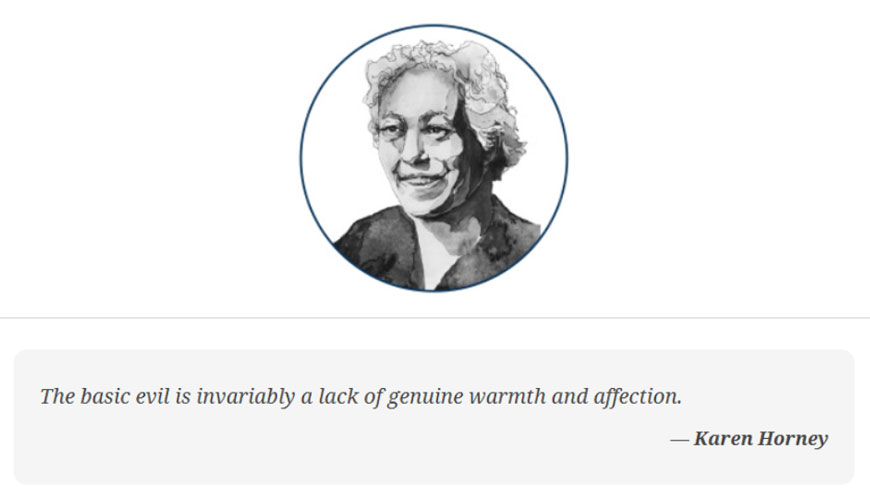
Source: Theories of personality by Schultz et al., 2024, Cengage Learning. Copyright 2025.
Karen Horney addressed the profound influence of social and cultural forces on the development of personality. Additionally, she recognized that different cultures and social groups view women’s roles in different ways.
Disenchanted by the patriarchal, pessimistic emphasis of psychoanalytic theory, Horney shifted her focus to the need for security and love. For her, childhood was dominated by the safety need, which is the need for security and freedom from fear. For her, feeling secure and having an absence of fear, as provided by one’s parents, were critical factors in determining the trajectory of personality development. If love and safety are experienced, the child will have normal personality development. If parents undermine a child’s need for safety, the child’s personality will likely become neurotic in some way. From this basis of Horney’s theory, we have concepts such as basic anxiety, neurotic needs and trends, womb envy, the tyranny of the shoulds, and feminine psychology.
4.1.1 Activity: Karen Horney: Neurotic Needs and Trends
4.1.2 Activity: Tyranny of the Shoulds
Feminine Psychology
Karen Horney made significant contributions to the understanding of gender roles, particularly concerning women, and how society shapes women’s psychological development. She was critical of the traditional Freudian views of women, which often framed them as inferior or naturally predisposed to certain psychological issues. Instead, Horney offered a more socially and culturally informed perspective, recognizing that women’s psychological struggles were often rooted in social conditions rather than biological determinism.
4.1.3 Activity: Motherhood or Career
Cultural and Societal Factors
Horney’s emphasis on the impact of cultural and social forces on an individual’s psychological development is not limited to gender roles. Consider the following questions:
- During your middle-childhood (ages 6–12), based on your observations of the world around you, did you set in place ideas about what you would like to do as an adult?
- How did the culture you were immersed in as a child affect the kind of person you are today?
- What do you find to be your most important priority at this time in your life?
- What occupations are suitable for you to pursue?
- Has your gender influenced what you are, and are not, allowed to do?
- How has society influenced the way you think about females (or yourself, if you are female, and how you think about other females)?
- Do you resonate with any of the neurotic trends proposed by Horney?
4.1.4 Activity: An Overview of Karen Horney’s Life and Theory of Personality
4.1.5 Activity: The Tyranny of the Shoulds – A Day of Reflection
Note: The following learning activity serves as a discussion prompt for this unit. Read it carefully and post your response in the corresponding discussion forum.

According to Karen Horney, some people experience a conflict between their “real self” and their “idealized self” due to the traumas of life. This leads them to try and do everything perfectly to gain the approval of others. To try to meet the goals of the “idealized self,” these people will engage in the “tyranny of the shoulds.”
As you go through your day, how often do you notice that your behaviour is being governed by “shoulds”? What is the source (or sources) of the “shoulds” for you? Write a paragraph (around 250-300 words) commenting on one or two of the “shoulds” and note whether or not you agree with the “shoulds” and how you might behave differently if they were not there. As you analyze your “shoulds,” feel free to use Adlerian language around inferiority, superiority, and the need for belonging.
Unit Summary
In Unit 4 you have had the opportunity to learn more about the neo-psychoanalytic theorist Alfred Adler and about Karen Horney. Adler’s individual psychology emphasized considering the totality of factors influencing a person to understand their attitudes and behaviours. The driving force in this theory of personality development is a person’s striving for superiority; if unsuccessful a person would develop an inferiority or superiority complex, leaving them with problems in coping with the challenges of everyday life, resulting in abnormal behaviour.
Karen Horney’s neo-psychoanalytic approach took into account sociocultural factors in the development of children and looked specifically at female developmental challenges such as the flight from womanhood and choosing between motherhood or career. Horney proposed that basic anxiety was the source of neurosis in a person’s life and outlined the 10 neurotic needs that may surface because of feeling lonely, hostile, and helpless.
Consequently, securing love and acceptance would become a dominant driving force in person’s life, veering them toward having a personality characterized by compliance, aggressiveness, or detachment.