Overview
After many decades of psychopathology being at the forefront of psychological investigation, humanistic psychologists proposed that the focus change to looking toward the highest potential of human beings. Where examining what could and does go wrong with people leads to a plethora of knowledge about disordered thinking, feeling, and acting, Abraham Maslow (1908–1970) and Carl Rogers (1902–1987) wanted to gather information about what helps people flourish in this life.
The humanistic approach represented a fundamental shift in psychology that greatly expanded topical knowledge and transformed the relationship between therapist and client. Holistic well-being in all areas of a person’s life was discussed in both theory and practice and now the client—not the therapist—was the expert of their own life. The theories and concepts of humanistic psychology have influenced virtually every system of contemporary life in areas such as education, health care, law enforcement, banking, politics, family functioning, counselling, and psychotherapy.
Topics
This unit is divided into the following topic(s):
- Carl Rogers: Self-Actualization Theory
Unit Learning Outcomes
When you have completed this unit, you will be able to:
- Evaluate Rogers’ concept of the self and the tendency toward actualization
- Analyze the experiential world and the development of the self in childhood
- Compare the characteristics of fully functioning persons
- Critique assessment and research of Roger’s theory
Learning Activities
Here is a list of learning activities that will benefit you in completing this unit. You may find it useful for planning your work.
Assessment
See the Assessment section in Moodle for assignment details.
Resources
Here are the resources you will need to complete this unit.
- Schultz, D. P., Schultz, S. E., & Maranges, H. M. (2024). Theories of personality (12th ed.). Cengage Learning.
- Other online resources will be provided in the unit.
8.1 Carl Rogers: Self-Actualization Theory
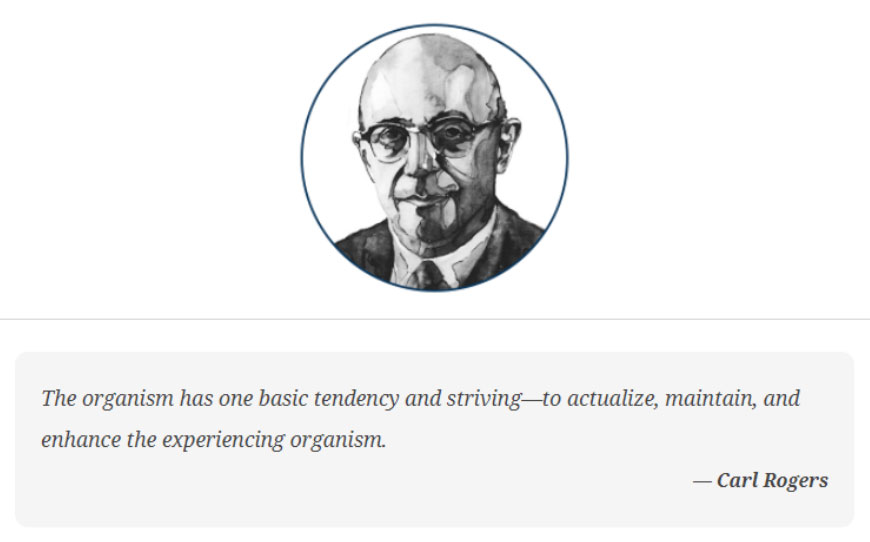
Source: Theories of personality by Schultz et al., 2024, Cengage Learning. Copyright 2025.
Like many of the theorists discussed in the textbook, Carl Rogers was raised with a religious duty and rule-oriented version of organized Christianity. He distanced himself from this way of thinking during his early adulthood; however, Rogers’ emphasis on unconditional positive regard (unconditional love or acceptance) seems to stem from the teachings of Jesus Christ. Rogers also describes authenticity (being truthful), genuineness, and empathy (compassion) as the necessary requirements for people to change their behaviour and want to become a fully functioning person. Rogers truly cherished people and saw his collaboration with clients and getting to know them deeply as a truly satisfying honour and privilege. His vision, theory development, and desire to see all people be treated with dignity and respect has had a profound effect on the field of psychology and human interaction around the world.
8.1.1 Activity: Carl Rogers: Self-Actualization Theory
Carl Rogers’ version of the humanistic approach fundamentally shifted the theory and application of psychotherapy in psychology. He transformed the way the therapeutic process was approached and researched; starting with shifting the relationship between therapist and client from one where the therapist was the expert, to the client being the expert of their life. He also emphasized holistic well-being in all areas of a person’s life, reducing the gap between a person’s ideal world (their expectations) and their real world, which moved a person to greater levels of congruence—a key term in Rogerian psychotherapy. Rogers’ work is far reaching; as you read this chapter, look for different spheres in your life where you can see the fingerprints of Rogers theory.
8.1.2 Activity: Carl Rogers on Empathy*
8.1.3 Activity: Humanistic Style Counselling
Note: The following learning activity serves as a discussion prompt for this unit. Read it carefully and post your response in the corresponding discussion forum.
Throughout his career, Rogers was consistent in his authentic care and compassion for people, constantly refining his therapy to more effectively help people see their strengths and resilience. He was critiqued on his use of audio and video recordings of therapist–client sessions as his preferred choice of data collection; however, this allowed him to microscopically analyze what was working and not working for both the therapist and client. Though Rogers preferred the qualitative method of analyzing audio or video content for changes in self-concept, he, and others, also used the Q-sort technique (QST), an empirical method of understanding self-image. The Q-sort technique quantitatively validated some of Rogers’ predictions regarding psychologically healthy and unhealthy responses to matters of self-image. It has also been revised for various research endeavours, for example, to provide support for aspects of sexual satisfaction, and more notably, factors in the “Big Five” theory. Ultimately, regardless of one’s opinion regarding Rogers, it is undeniable that his theory has had a profound influence on the way people are understood and how therapy is practiced. Thanks to Rogers, we know that people grow best in environments where there’s genuineness (authenticity), acceptance (unconditional positive regard), and empathy (feeling with, not for, a person).
Unit Summary
In this unit you have had the opportunity to learn about the contributions of Carl Rogers to humanistic psychology. The work of Rogers, along with that of Maslow—which we have covered in the previous unit—set the groundwork for the trajectory of motivational theory, which became the third force in the field of psychology. This theory’s appeal is nested in the actualization tendency, which is the humanistic explanation for every person’s innate desire to move toward maximizing their potential. According to motivational theory, when this tendency is thwarted it produces distress that can manifest in multitudinous ways in the individual’s experience.