Overview
Have you ever wondered why you desire to be affirmed and long to be significant in a unique way? From a Biblical perspective, there is a clear indication that God has created each of us like no other. In the Psalms, it is succinctly stated that we have been fearfully and wonderfully made (139:14). In this way, we can see this internal desire for edification as recognition of our unique and individual characteristics as determined by our Creator.
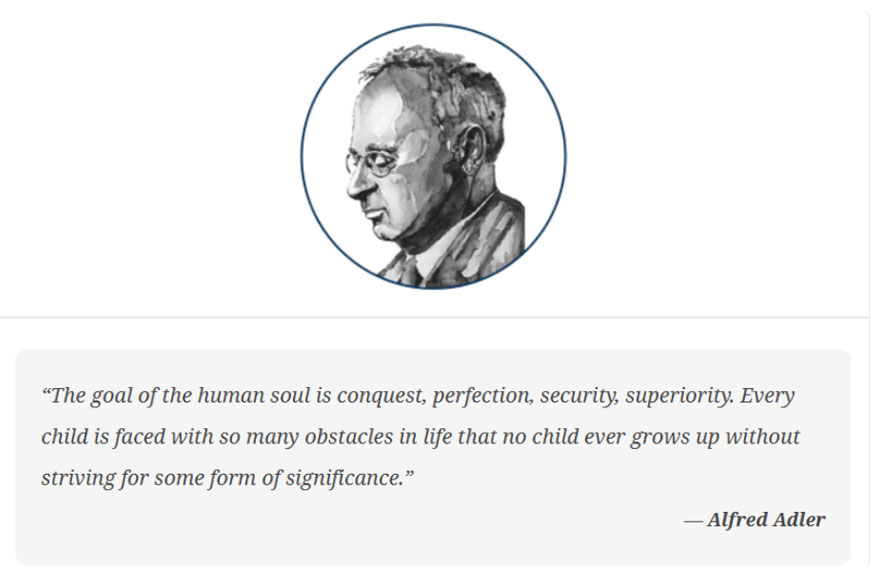
Keeping this in mind, we can segue to the neo-psychoanalytic approaches of Alfred Adler (1870–1937) in this unit. Adler’s theory focused on a person’s active engagement in creating themselves and moving toward a desired future state. He believed all people are born with a sense of inferiority and insignificance and spend their lives overcoming these feelings by striving for superiority. The focus of this theory is on social factors that contribute to a person’s conscious construction of their individual uniqueness and, ultimately, to the formation of one’s personality.
Topics
This unit is divided into the following topic(s):
- Alfred Adler: Individual Psychology
Unit Learning Outcomes
When you have completed this unit, you will be able to:
- Analyze the life of Adler and his concept of feelings of inferiority and striving for superiority
- Evaluate styles of life and Adler’s ideas on birth order
- Critique assessment and research on Adler’s theory
Learning Activities
Here is a list of learning activities that will benefit you in completing this unit. You may find it useful for planning your work.
- Read Chapter 4, “Alfred Adler: Individual Psychology,” in the textbook.
- Recall the inferiority and superiority feelings described in the textbook and reflect on the TED talk.
- Watch a video that provides a summary of Adler’s birth order theory and reflect on your own context.
- Watch a video to learn more about the assumptions underlying Adler’s theory of individual psychology.
Note: Working through course activities will help you to meet the learning outcomes and successfully complete your assessments.
Assessment
See the Assessment section in Moodle for assignment details.
Resources
Here are the resources you will need to complete this unit.
- Schultz, D. P., Schultz, S. E., & Maranges, H. M. (2024). Theories of personality (12th ed.). Cengage Learning.
- Other online resources will be provided in the unit.
Alfred Adler: Individual Psychology
Source: Theories of personality by Schultz et al., 2024, Cengage Learning. Copyright 2025.
As we begin, consider areas in your life where you feel proud, successful, recognized, jealous, avoidant, or defensive. How did this come to be? What motivated you to focus on certain activities and shy away from others?
Adler would suggest that your movement in life was directed externally by social factors, and internally by a striving for significance. Adler titled his approach to personality as individual psychology. His use of the word individual comes from the Latin word individuum, which means indivisible.
Thus, his personality theory was centered on the unity and indivisibility of the person and emphasized understanding the whole person rather than parts of a person (e.g., Freud’s id, ego, superego)—all aspects of ourselves in relationship to one’s socially embedded contexts—and their pursuit of life goals.
Adler stressed that healthy individuals are guided by social interest and aim to become socially useful members of society. We can thank Adler for introducing us to concepts such as inferiority and superiority complexes, the importance of birth order, and the creative power of the self.
Activity: Alfred Adler: Individual Psychology
Read Chapter 4, “Alfred Adler: Individual Psychology,” in Theories of Personality (Schultz et al., 2024).
Adler was interested in making his theory useful to the general public (as noted in the textbook, Adler could be considered the first “pop psychologist”). Due to the ease of understanding and application of his concepts, it is highly recommended that as you read this chapter and watch the upcoming video on Adler (which complements the textbook reading) you engage and interact with different parts of his theory.
Use the following interactive slides to support your reading. They provide a brief summary and key points for each section, designed to guide your active reading—much like a navigation map!
Activity: Inferiority and Superiority Feelings
Recall the sections “Inferiority Feelings: The Source of All Human Striving,” “Striving for Superiority or Perfection,” and “The Style of Life” from the textbook, and consider the following questions:
- Do you agree with Adler that we have a basic sense of inferiority as children?
- Can you think of times from your childhood when, due to your small stature and lack of experience, you felt incapable of surpassing someone older than you?
- Do you still wrestle with insecurity in different areas of your life?
- Is there any evidence of an inferiority or superiority complex in your present behaviours?
- What strategies did you adopt to compensate for perceived weaknesses?
After reflecting on these questions, watch To Overcome Challenges, Stop Comparing Yourself to Others | Dean Furness (Furness, 2020) to learn how the presenter overcame challenges. What strategies did he use? What aspects of his journey stood out to you the most? How can you apply Adler’s theories to his experience?
Activity: Birth Order
Adler developed the birth order theory, which suggests that a person’s position in the family can influence their personality and behaviour. Do you align with his descriptions relating to family constellation? Do you differ? Do you still behave as an adult in ways you were introduced to as a child?
How Birth Order Can Shape Your Personality (BRIGHT SIDE, 2017) provides a summary of Adler’s birth order theory. As you watch, reflect on your own birth order and consider the questions listed above.
Here are some additional interesting resources for you to explore. Perhaps we can verify Adler’s birth order theory by looking at real-life examples of well-known people. While these examples are not grounded in solid scientific foundations, it will be interesting to see how Adler’s theory applies in real life.
If you’re the youngest child in your family, I encourage you to find similar resources to get more insights!
Additionally, here’s an interesting discussion, How Your Birth Order Affects Your Parenting (Focus on the Family, 2020). In this video, you’ll have the chance to reflect on your parent’s style or your own approach if you have a child.
Activity: Adler’s Theory of Individual Psychology
Watch Adler’s Theory of Individual Psychology (Mister Simplify, 2019) to learn more about assumptions underlying Adler’s theory of individual psychology. You’ll also be introduced to some of his more influential concepts such as birth order (which we explored in the previous activity) and personality types.
In this activity, pay attention to the personality types, starting at 5:03 in the video. Which personality type is most representative of how you approach life today (note that the terms used in the video differ from the textbook)? Do you have a desired state of being that’s driving your present priorities and actions (this relates to Adler’s idea named fictional finalism)?
Unit Summary
In Unit 3, you have had the opportunity to learn about the neo-psychoanalytic theorist Alfred Adler. Adler’s individual psychology emphasizes considering the totality of factors influencing a person to understand their attitudes and behaviours. The driving force in this theory of personality development is a person’s striving for superiority; if unsuccessful a person would develop an inferiority or superiority complex, leaving them with problems in coping with the challenges of everyday life, resulting in abnormal behaviour.
Before you move on to the next unit you may want to check that you are able
- Analyze the life of Adler and his concept of inferiority feelings and striving for superiority
- Evaluate the styles of life and Adler’s ideas on birth order
- Critique assessment and research in Adler’s theory
References
BRIGHT SIDE. (2017). How birth order can shape your personality. In YouTube. https://www.youtube.com/watch?v=kcXTGFrKx5A.
Focus on the Family. (2020). How your birth order affects your parenting - Kevin Leman and Sally Funn. In YouTube. https://www.youtube.com/watch?v=SsU4bFJ0CA8.
Furness, D. (2020). To overcome challenges, stop comparing yourself to others. In YouTube. https://www.youtube.com/watch?v=IOrmS8vJDQw.
Gold, S. S. (n.d.). 22 famous people you didn’t know are middle children. In Reader’s Digest.
Mister Simplify. (2019). Adler’s theory of individual psychology - Simplest explanation ever. In YouTube. https://www.youtube.com/watch?v=MJUBHyxDq6Y.
Schultz, D. P., Schultz, S. E., & Maranges, H. M. (2024). Theories of personality (12th ed.). Cengage Learning.
Wu, M. (2024). These 15 celebs have such oldest child energy. In PureWow. https://www.purewow.com/entertainment/celebs-with-oldest-child-energy.