Overview
In the previous unit we learned about the work of B. F. Skinner, one of the two influential figures in the behaviourist movement. In this unit, we will learn about the work of Albert Bandura.
While Skinner’s work with rats and pigeons established behaviourism as a learning theory, his model of explaining observed behaviour was not capable of accounting for all animal behaviour, especially human behaviour. Albert Bandura (b. 1925), noting this weakness in Skinner’s behaviourism, put forth a different kind of learning approach called the social cognitive theory. This theory emphasized that even though humans can be shaped by rewards and punishments, they are more powerfully influenced by watching others. He calls this observational learning, which involves learning new (or adjusting existing) behaviours through watching another human modelling that behaviour.
Topics
This unit is divided into the following topic(s):
- Albert Bandura: Modelling Theory
- Course Summary
Unit Learning Outcomes
When you have completed this unit, you will be able to:
- Assess Bandura’s concept of modelling and the basis of observational learning
- Evaluate the processes of observational learning, self-reinforcement, and self-efficacy
- Critique behaviour modification, assessment, and research on Bandura’s theory
Learning Activities
Here is a list of learning activities that will benefit you in completing this unit. You may find it useful for planning your work.
Assessment
See the Assessment section in Moodle for assignment details.
Resources
Here are the resources you will need to complete this unit.
- Schultz, D. P., Schultz, S. E., & Maranges, H. M. (2024). Theories of personality (12th ed.). Cengage Learning.
- Other online resources will be provided in the unit.
10.1 Albert Bandura: Modelling Theory
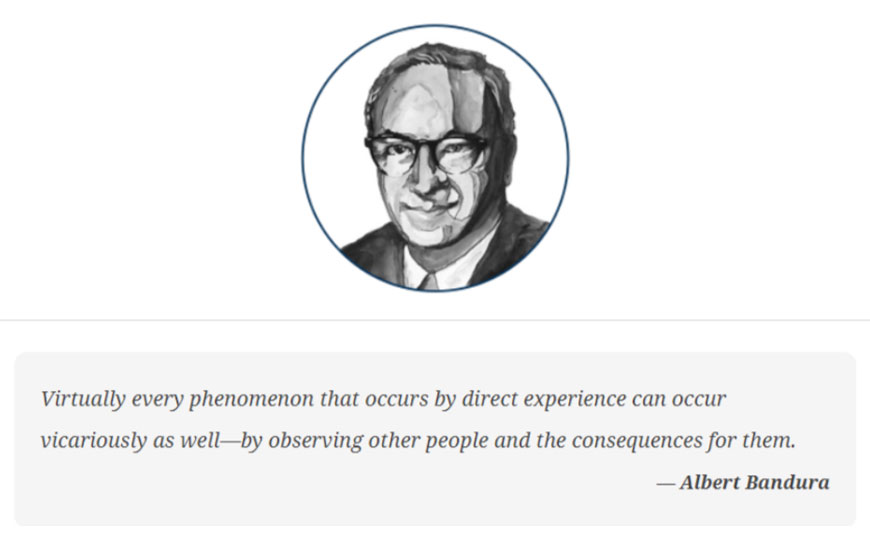
Source: Theories of personality by Schultz et al., 2024, Cengage Learning. Copyright 2025.
Albert Bandura agreed with Skinner on some points concerning operant conditioning; however, he strongly disagreed with Skinner’s belief that people were simply reactive organisms controlled by environmental factors. He observed and gathered evidence to prove people use their cognitive and emotional insights to inform them about their life choices. His work extended the purview of behaviourism to include the concept of self-efficacy, which influences a person’s motivation and actions (along with modelling, which is the primary mode of acquiring behaviours in observational learning). Bandura demonstrated that decision making is dynamic and is constantly affected through the concept of triadic reciprocal interaction. This is when one’s thoughts or affect dispositions, environment, and behaviours are constantly influencing one another. A change in one of these factors imposes change on the other two.
10.1.1 Activity: Albert Bandura: Modelling Theory
Like those of Skinner, the major theoretical constructs of Bandura’s theory are easily amenable to experimentation; consequently the social cognitive approach has a tremendous amount of empirical research support. Behaviour modification (watching a model and copying the behaviour) has been shown to help people quickly reach their therapeutic goals, and seems to produce long-term changes in behaviour. The direct observation assessment technique can be easily manipulated to produce recordable differences in behavioural outcomes that can be applied to individual or group behaviour in virtually every context a human being finds themself in. The enormous amount of research supporting the social cognitive (aka, social learning) approach, its explanatory power, and its applicability, makes this one of the most power psychological theories ever developed.
10.1.2 Activity: Bobo Doll Experiment
10.1.3 Activity: Reflection on the Processes of Observational Learning
10.1.4 Activity: Self-Reinforcement and Self-Efficacy
10.1.5 Activity: Critique on Skinner’s Views on Free Will
Note: The following learning activity serves as a discussion prompt for this unit. Read it carefully and post your response in the corresponding discussion forum.
Albert Bandura, while alive, was the most cited psychologist of our time; he is also considered the fourth most influential psychologist of all time after Sigmund Freud, B. F. Skinner, and Jean Piaget, respectively. By elaborating on behaviourism and incorporating investigation about the importance of internal and social processes, Bandura’s social cognitive approach became a powerful explanatory perspective regarding why people behave in the ways that they do. Studies involving components of Bandura’s triadic reciprocal determinism—looking at one’s personal dispositions, their behaviour, and the environment—has profoundly elevated knowledge and understanding regarding human motivation and functioning. In particular, Bandura’s concept of self-efficacy has been shown to have a strong relationship with causal attributions having wide-ranging applications across many different facets of life. Bandura’s award-winning efforts demonstrating the reliability and usefulness of social learning theory set in motion a work that will continue shaping the discipline of psychology far into the future.
10.2 Course Summary
This course has presented to you an overview of some of the most influential theorists and theories in the field of personality psychology. The 10 major approaches covered in this course include:
- Psychoanalysis
- Analytical psychology
- Individual psychology
- Feminine psychology
- Motivation and personality
- The trait perspective
- Needs–Hierarchy theory
- Self-Actualization theory
- Reinforcement theory
- Modelling theory
Each of these foundational perspectives are still influential in theory development and application in modern-day personality psychology. If you choose to carry on with the application of personality testing, know that you have entered a field with endless possibilities of personal specialization. Personality testing is in demand in many facets of society, helping people and organizations to grow and maximally enjoy their unique constitution, relationships, academic or vocational choices, and financial decisions.
I sincerely hope that this course has enhanced your appreciation for who you and others are and has increased your appreciation for the complex content that the field of psychology chooses to explore. Though this course has been done in an accelerated fashion, I pray that you have a sense of calm and satisfaction as you prepare to complete your final assessments.
Congratulations to you for all your hard work!
Unit Summary
Over the last two units you have had the opportunity to learn about two influential figures in the behaviourist movement: B. F. Skinner and Albert Bandura. Skinner’s operant conditioning learning theory and Bandura’s social cognitive theory have greatly contributed to the behaviourist mega-theory and its robust explanatory power. Behaviourism and its applications are both ubiquitous and universal. Today, they have had a tremendous effect not only in the fields of psychology and psychiatry, but also in education, medicine, athletics, business, politics, international relations, and the penal system.